
Loading...
Cold floors and musty smells in your Nipomo home usually trace back to what is - or is not - in the crawl space. Proper insulation and moisture control fix both problems at the source.
Crawl space insulation in Nipomo, CA, acts as a thermal and moisture barrier between the cool, damp ground beneath your home and the living floors above it - most projects take one to two days and are done entirely below your floors without disrupting your daily routine. Without it, cold air and moisture from the soil work their way up, making your floors uncomfortable and pushing your heating system to compensate. Many homes on the Nipomo Mesa were built in the 1970s through 1990s under standards that are now considered inadequate, and a significant share of them have crawl space insulation that has never been replaced.
Nipomo's location near the coast means the ground under your home stays damp for much of the year. That moisture evaporates upward into the space below your floors, and if insulation is installed without addressing it first, the result is damp insulation that traps moisture against your floor joists over time. A contractor who comes out and checks the crawl space before quoting is the contractor you want - not one who prices the job over the phone.
Crawl space insulation is often the companion to a crawl space vapor barrier installation - moisture control on the ground and insulation on the floor joists work together as a system. Homes with wall insulation gaps also benefit from addressing the crawl space at the same time to complete the thermal envelope.
If you walk across your kitchen or hallway in the morning and the floor feels noticeably cold even on a mild Nipomo day, the space below is not insulated well enough to buffer the overnight air. This is especially common in homes built before the 1990s, where original crawl space insulation may be thin, compressed, or missing in spots. It is one of the most reliable signals that the crawl space needs attention.
A persistent musty or earthy smell in ground-floor rooms - especially after rainy periods or heavy marine layer - often means moisture is moving up from the crawl space. Nipomo's coastal humidity makes this more likely than in drier parts of California. Left alone, damp insulation leads to mold growth and wood damage that costs far more to fix than the original insulation job.
If you open the crawl space access hatch and look in with a flashlight, you may see insulation batts that have drooped, fallen, or been pushed aside. Fallen insulation is not doing anything - and it creates an easy entry point for pests. You can check this yourself without any special tools. If you see hanging batts, the material needs to be replaced, not just pushed back up.
Many Nipomo homes built in the 1970s through early 2000s have never had their crawl space insulation evaluated. If you have owned your home for years and no one has looked under there, the insulation is likely degraded, compressed, or partially missing - especially after several wet winters. A professional inspection takes 30 to 60 minutes and gives you a clear picture of what is actually there.
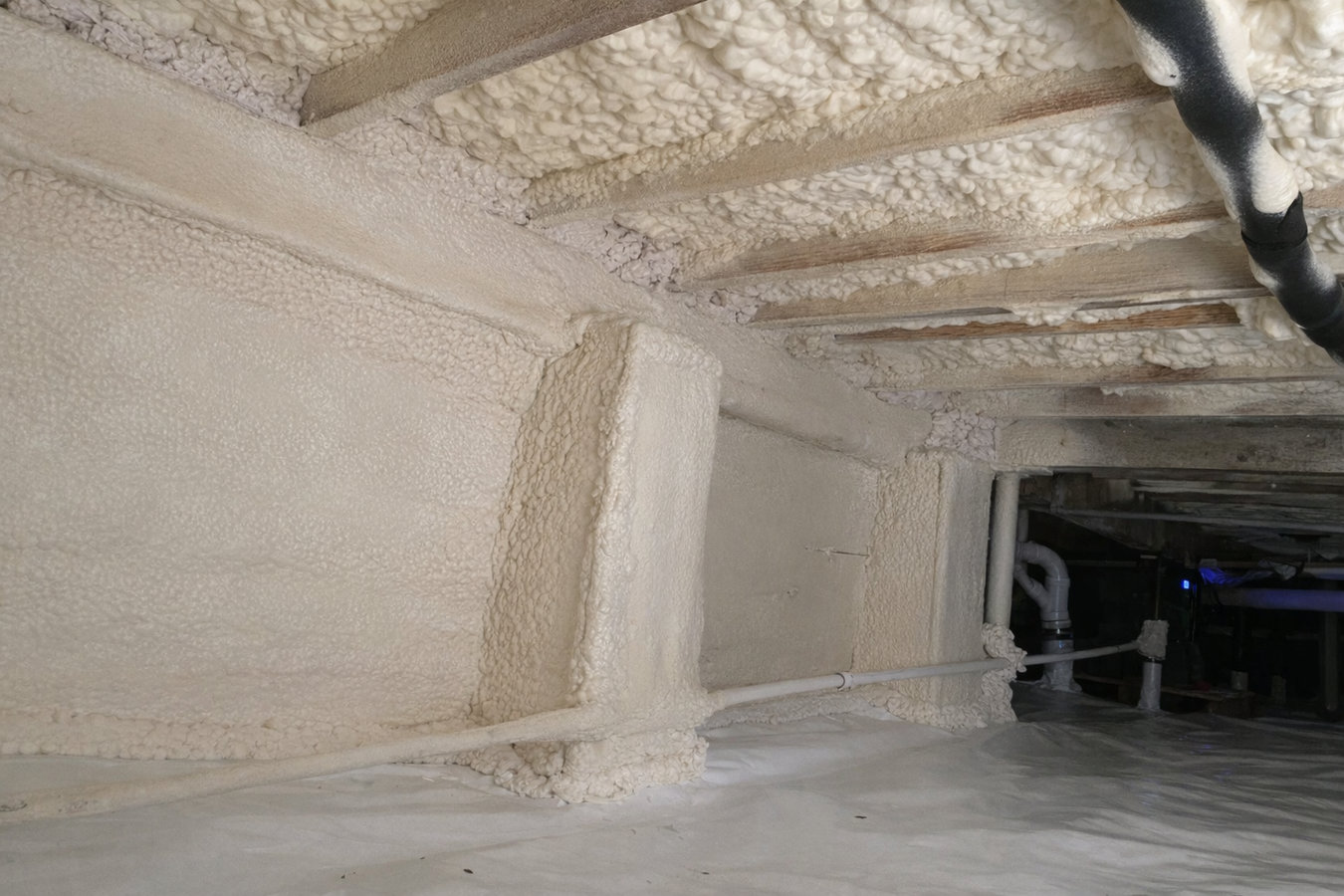
We offer both the traditional floor joist method - fitting insulation batts between the joists above the crawl space - and the conditioned crawl space approach, which seals and insulates the walls of the crawl space itself. The wall method is increasingly common in coastal California because it controls moisture more effectively. We will tell you which one fits your home after we look, not before. If old insulation needs to come out first, we handle that removal as part of the same project.
Moisture control is always part of the conversation. We check for standing water, soil dampness, and existing vapor barrier condition before any insulation goes in. When a crawl space vapor barrier is needed, we can install it in the same visit. We also seal penetrations and gaps around pipes and wiring where air and moisture enter - details that a quick job often skips but that matter for long-term performance. For homes where the crawl space connects to wall cavities with gaps, we can address those at the same time.
Best for vented crawl spaces where adding insulation between joists is the right fit - a straightforward upgrade for most older Nipomo homes.
For homes where moisture is a consistent problem - sealing and insulating the walls creates a drier, more stable space that also insulates better year-round.
For Nipomo homes where the ground is damp - insulation and moisture barrier installed together as a complete system.
For homes with damaged, compressed, or pest-contaminated existing insulation - old material removed, space cleaned, and new insulation installed in the same project.
Nipomo sits in the Santa Maria Valley near the Pacific coast, and the marine layer that rolls in from the ocean - thick morning fog that is especially heavy in spring and early summer - keeps the air and soil damp on a regular basis. That persistent moisture means crawl spaces here are more prone to moisture buildup than in drier inland areas, and any insulation job that skips a proper ground vapor barrier is likely to fail faster than it should. Moisture control is not an optional add-on for homes in this area - it is the foundation of a crawl space job that will actually hold up over time.
Nipomo also has some of the oldest housing stock on the Central Coast, with much of the residential development on the mesa dating from the 1970s through 1990s. Homeowners in nearby Oceano and Arroyo Grande face the same combination of older homes and coastal conditions. Because Nipomo is unincorporated, permits and inspections are handled through San Luis Obispo County - and a contractor who knows the county's requirements will handle that paperwork on your behalf. The U.S. Department of Energy estimates that well-sealed, well-insulated crawl spaces can reduce heating and cooling costs by 10 to 20 percent in many homes - and in Nipomo, where floors have historically been a weak point, that savings is real.
We respond within 1 business day. You do not need to know anything specific about your crawl space - we just ask about your home's age, any symptoms you have noticed, and whether anyone has looked under the house recently. No preparation needed on your end.
A technician enters the crawl space through the access hatch - usually a closet or exterior wall - and checks the insulation, moisture levels, and vapor barrier. This takes 30 to 60 minutes, and you receive a written quote covering the full scope before any work is scheduled.
The crew arrives with all materials and equipment. If old insulation comes out first, that happens before anything new goes in. The work stays entirely below your floors - you will hear movement and occasional noise, but your routine is not disrupted.
When the job is done, the crew clears all debris and walks you through what was done - with photos if the crawl space is tight. If a county inspection is required, we coordinate it. The insulation is effective immediately - no curing or drying period needed.
We come out, check the crawl space in person, and give you a written quote with no obligation. If the insulation is fine, we will tell you that too.
(805) 723-9619We check for ground moisture and vapor barrier condition before any insulation goes in. Skipping this step is the main reason crawl space insulation fails ahead of schedule. We do not install over a problem - we identify it first.
Because Nipomo is unincorporated, the county handles permits and inspections. We know what triggers a permit requirement and handle the coordination from start to finish so the paperwork does not fall to you.
Many homes on the Nipomo Mesa have low-clearance crawl spaces that require more time and care than a standard attic job. We work in these spaces regularly and quote them accurately - no surprise upcharges once the crew is under your house.
BPI-certified contractors are trained to understand how insulation, moisture, and ventilation work together as a system. That knowledge matters in a coastal area like Nipomo, where one problem often connects to another. We follow Building Performance Institute guidelines on every crawl space project.
Every crawl space project we complete in Nipomo starts with an honest assessment and ends with documentation of what was done. Whether the job is a simple batt replacement or a full conditioned crawl space conversion, you will know exactly what you paid for and why.
Extend your home's thermal envelope from the crawl space up through the walls to stop heat loss at every level.
Learn MoreA ground vapor barrier is the moisture control layer that makes crawl space insulation last in Nipomo's coastal climate.
Learn MoreNipomo's wet season makes crawl space moisture worse - schedule your free estimate now and get your home protected before conditions get harder to deal with.